
Sweet Analytics: 360 marketing analytics platform for ecommerce leaders
Category: ecommerce
Services: DevOps, Cloud Architecture Design and Review, Managed Engineering Teams.
Category: ecommerce
Services: DevOps, Cloud Architecture Design and Review, Managed Engineering Teams.

Sweet Analytics is a marketing and customer analytics platform that offers services to eCommerce retailers. It provides a tool to automate marketing data in one place, grow sales, and understand customers better.
Our customer, Sweet Analytics is a marketing and customer analytics platform catering especially to the eCommerce industry. The client was experiencing limitations in terms of scalability, availability, integration, and security due to the fact that its cloud infrastructure was hosted on DigitalOcean.
As the platform grew and required more resources, it started experiencing performance issues and limited global coverage. Additionally, the platform faced challenges in integrating with other services and ensuring data security, which hindered its ability to serve its customers effectively.
We were able to provide the solutions to the problems faced by Sweet Analytics by utilizing Amazon EKS and several other AWS and third-party services.
As a key component of the solution, we utilized Amazon EKS to provide a scalable and reliable solution for Sweet Analytics. Amazon EKS allowed us to manage and orchestrate containerized applications seamlessly, providing an easy-to-use platform for deploying, scaling, and managing containerized applications. It also provided several built-in features for high availability, scalability, and security, which were essential for Sweet Analytics’ growing platform. The integration capabilities of Amazon EKS with other AWS services like Amazon RDS, AWS Lambda, and AWS KMS also helped us in building a fully integrated and secure platform for Sweet Analytics.
Our team set up a scalable and fault-tolerant infrastructure by using Karpenter for auto-scaling and Nginx ingress for load balancing. This ensured that the platform could handle large workloads and traffic spikes without performance issues.
For data security, we used AWS KMS for encryption and AWS IAM for access control, which provided robust security features to protect the sensitive data of the customers.
Finally, we set up monitoring and alerting using Grafana, Prometheus, and Loki, which helped in detecting and resolving issues proactively.
Our team has built a CI-CD pipeline for each microservice deployed in the application. This helps us achieve faster deployment time.
We helped the client create the following modules
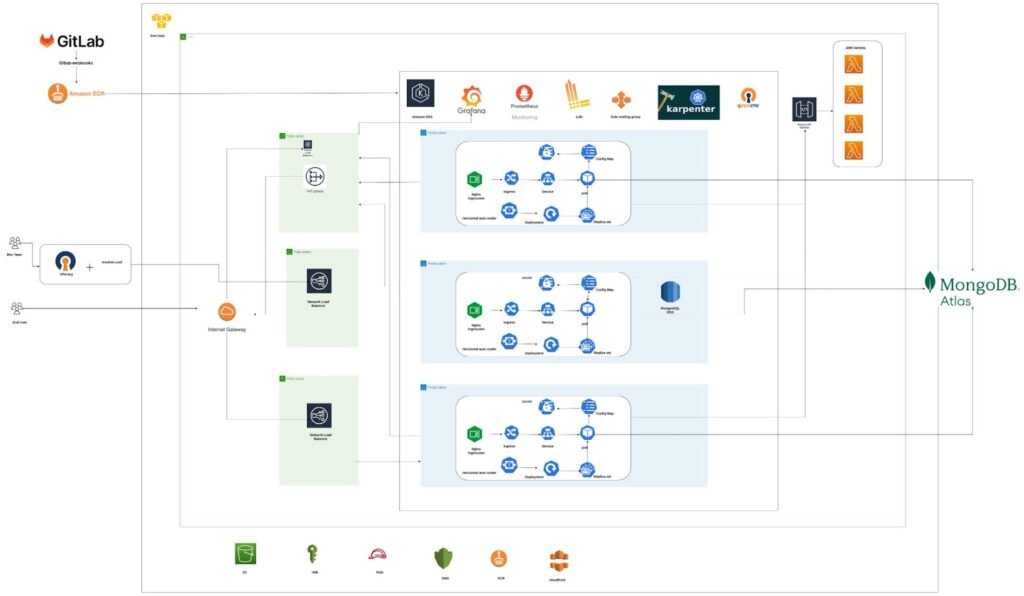
Using these monitoring tools, Simform can proactively identify and resolve issues before they impact end-users, ensuring a high level of performance and availability for the client’s microservices-based architecture.



We do not collect any information about users, except for the information contained in cookies. We store cookies on your device, including mobile device, as per your preferences set on our cookie consent manager. Cookies are used to make the website work as intended and to provide a more personalized web experience. By selecting ‘Required cookies only’, you are requesting Simform not to sell or share your personal information. However, you can choose to reject certain types of cookies, which may impact your experience of the website and the personalized experience we are able to offer.
We use cookies to analyze the website traffic and differentiate between bots and real humans. We also disclose information about your use of our site with our social media, advertising and analytics partners. Additional details are available in our Privacy Policy.
These cookies are necessary for the website to function and cannot be turned off.
Under the California Consumer Privacy Act, you may choose to opt-out of the optional cookies. These optional cookies include analytics cookies, performance and functionality cookies, and targeting cookies.
Analytics cookies help us understand the traffic source and user behavior, for example the pages they visit, how long they stay on a specific page, etc.
Performance cookies collect information about how our website performs, for example,page responsiveness, loading times, and any technical issues encountered so that we can optimize the speed and performance of our website.
Targeting cookies enable us to build a profile of your interests and show you personalized ads. If you opt out, we will share your personal information to any third parties.